

How to Use Tax Efficiency ETFs to Save Your Gains
Save your investment gains! Learn how a tax efficiency etf structurally reduces taxes compared to mutual funds for better returns.

A tax efficiency ETF is a great tool for people who make a lot of money. It helps you keep more of what you earn. Many people do not know how much taxes take away from their profits every year.
Here is a quick comparison of how ETFs and mutual funds stack up on taxes:
| Factor | ETF | Mutual Fund |
|---|---|---|
| % distributing capital gains (2024) | 5% | 43% |
| Redemption method | In-kind (no taxable sale) | Cash (forces taxable sales) |
| Typical portfolio turnover | Low (often under 5%) | Higher |
| Tax-cost ratio (large-blend, 3yr) | Low | ~1.28% median |
| Investor controls tax timing | Yes | No |
Most normal mutual funds did well lately. But investors in the highest tax bracket lost about 7% of their gains to taxes over ten years. That is a lot of money. For someone earning $400K or more, these taxes add up to a big loss over time.
ETFs are built differently. Their setup reduces taxes inside the fund. You do not pay taxes because of what other investors do. You stay in control.
I am Daniel Delaney, founder of Seek & Find Financial. Throughout my career, I have worked hands-on with investors. I help them build portfolios using a tax efficiency ETF strategy. This helps protect your gains over a long time. In this guide, I will show you how it works.
Investing involves risk, including possible loss of principal. No investment strategy can ensure financial success or guarantee against losses. Past performance may not be used to predict future results. Provided content is for overview and informational purposes only, reflect the opinions of the author, and is not intended and should not be relied upon as individualized tax, legal, fiduciary, or investment advice.
This information is being provided only as a general source of information. These views may change as market or other conditions change. This information is not intended and should not be used to provide financial advice and does not address or account for an individual's circumstances. Past performance does not guarantee future results and no forecast should be considered a guarantee. Please seek the guidance of a financial professional regarding your particular financial concerns.
Investment advisory services offered by duly registered individuals through Seek & Find Financial LLC a Registered Investment Adviser. Licensed Insurance Professional.
When we talk about a tax efficiency ETF, we are really talking about how the fund is built. Think of a mutual fund like a big shared pot of soup. If one person wants to leave the dinner party and take their portion of soup home, the chef might have to sell some of the ingredients to get the cash. When the chef sells those ingredients, everyone still at the table has to help pay the tax bill on the profit.
An ETF is more like a potluck where everyone brings their own sealed containers. If someone leaves, they just take their container with them. The people staying at the party don't get stuck with a bill. This is why How Are ETFs Tax Efficient? Key Insights To Know | iShares is such a vital concept for our clients in places like Crown Point or Chicago who are looking to protect their hard-earned gains.
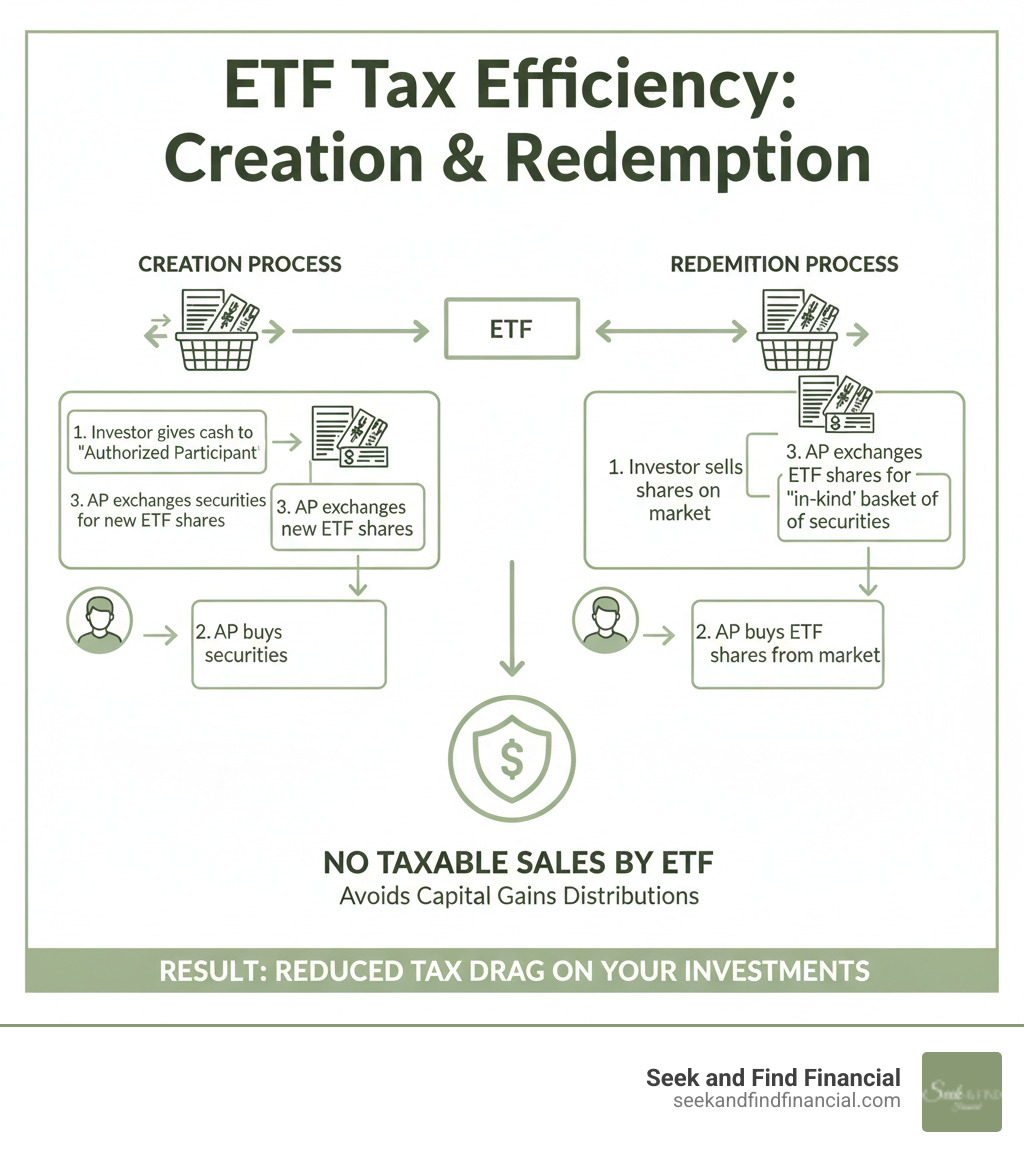
The secret sauce of an ETF is the "in-kind" process. Most investors buy and sell ETF shares on an exchange, just like a stock. This is called the secondary market. Because you are trading with another investor, the fund manager doesn't have to sell any stocks to give you your money.
When big institutions (called Authorized Participants) want to create or redeem large blocks of shares, they use "creation units." Instead of using cash, they swap a basket of the actual stocks for the ETF shares. This "in-kind" swap is not considered a taxable sale by the IRS.
This process also allows for smart cost basis management. When an ETF needs to send stocks out of the fund to a big institution, the manager can pick the shares that have the lowest cost basis (the ones with the biggest potential tax bill). By sending those shares out "in-kind," the fund gets rid of the tax liability without ever triggering a capital gain for the remaining shareholders.
Another reason a tax efficiency ETF works so well is low turnover. Most ETFs track an index, like the S&P 500. As of late 2024, about 92% of all ETF assets were in these indexed products.
Index funds don't trade very often. They only buy or sell when the index itself changes. Many popular ETFs have a turnover rate of 5% or less. Compare that to some active mutual funds that might swap out 50% or more of their stocks every year. Every time a fund sells a stock for a profit, it creates a taxable event. By keeping turnover low, ETFs keep those tax bills away from your mailbox.
The data is pretty clear: ETFs are winning the tax war. In 2024, only about 5% of all ETFs sent out a capital gains distribution. Meanwhile, 43% of mutual funds hit their investors with a tax bill.
| Feature | ETF | Mutual Fund |
|---|---|---|
| Redemption Basis | In-kind (Shares for Shares) | Cash (Selling holdings) |
| Trading Location | Secondary Market (Exchange) | Primary Market (Direct with Fund) |
| Tax Control | High (You decide when to sell) | Low (Manager decides when to sell) |
| Cost Basis | Managed via in-kind swaps | Average cost often used |
Mutual funds are often forced to sell stocks to pay out investors who are leaving the fund. If the market is up and many people want to "cash out," the manager has to sell winners to get that cash. This creates capital gains. Even if you didn't sell a single share of your mutual fund, you still have to pay your portion of the taxes on those sales.
This is the "tax trap." You could actually lose money on your investment in a bad year but still owe taxes because the fund manager was forced to sell stocks that had grown over the last decade. With a tax efficiency ETF, this rarely happens because of the exchange-traded nature of the shares.
We use a metric called the tax-cost ratio to show how much of your return is being eaten by taxes. For typical large-blend mutual funds, the median tax-cost ratio was 1.28% over a recent three-year period.
That might sound small, but if your fund returns 10%, a 1.28% tax-cost ratio means you are losing more than 12% of your profit to Uncle Sam every year. For a core bond fund, the ratio is often around 1.44%. When interest rates are low, losing 1.44% to taxes can represent a massive chunk of your total income. Using a tax efficiency ETF helps keep that ratio as close to zero as possible.
Building a tax-smart portfolio isn't just about picking one fund; it is about looking at your whole financial picture. For our clients earning $400K+, we focus on "asset location." This means putting the right investments in the right types of accounts.
For your taxable brokerage account, you generally want broad, low-turnover index ETFs. Funds like the Vanguard Total Stock Market ETF (VTI) or the iShares Core S&P 500 ETF (IVV) are gold standards.
Qualified dividends are great because they are taxed at lower capital gains rates (0%, 15%, or 20%) rather than your higher ordinary income tax rate. If you are in a high tax bracket in Chicago or Merrillville, this difference is huge.
International ETFs, like the iShares Core MSCI Total International Stock ETF, often have higher dividend yields (around 3.05%) compared to US stocks (around 1.09%). This means they might have a slightly higher tax-cost ratio, but they also offer foreign tax credits that can help offset some of the cost.
Bonds are trickier. Most bond interest is taxed as ordinary income. If you are in a high tax bracket, we often look at municipal bond ETFs. These funds provide income that is usually free from federal taxes, and sometimes state taxes too, making them a very specific type of tax efficiency ETF for your taxable account.
Once you have the right ETFs, you can use advanced strategies to squeeze even more value out of your plan. At Seek & Find Financial, we use technology like Altruist to help automate these moves.
A simple rule of thumb:
Tax efficiency isn't a "set it and forget it" thing. We recommend a quarterly check-up. We look at:
Just remember the "wash-sale rule": you can't buy the exact same security within 30 days of selling it for a loss, or the IRS will disallow the tax benefit.
Surprisingly, yes! While active ETFs trade more often, they still use the same "in-kind" redemption process. An active manager can use the redemption process to get rid of high-gain stock positions just like an index fund manager does. This makes an active tax efficiency ETF much more tax-friendly than an active mutual fund.
Specialized ETFs have different rules.
It is rare, but it happens. If an ETF invests in certain emerging markets (like Brazil or India), those countries might not allow "in-kind" transfers. The fund has to sell the stocks for cash, which can trigger a tax bill. Also, if a fund is very small and has a lot of people leaving at once, it might be forced to sell holdings for cash.
Managing your wealth isn't just about how much your portfolio grows; it is about how much of that growth you actually get to keep. For entrepreneurs and business owners in Indiana and Illinois, a tax efficiency ETF strategy is a foundational piece of a smart financial plan.
By understanding the mechanics of in-kind redemptions, keeping an eye on turnover, and placing your assets in the right accounts, you can significantly reduce the "tax drag" on your wealth. At Seek & Find Financial, we specialize in building these structured, technology-driven plans to help you reach your long-term goals without giving away more to the IRS than necessary.
If you are ready to stop the quiet erosion of your wealth and start a more disciplined, tax-aware investment journey, we are here to help. More info about our services
Investing involves risk, including possible loss of principal. No investment strategy can ensure financial success or guarantee against losses. Past performance may not be used to predict future results. Provided content is for overview and informational purposes only, reflect the opinions of the author, and is not intended and should not be relied upon as individualized tax, legal, fiduciary, or investment advice.
This information is being provided only as a general source of information. These views may change as market or other conditions change. This information is not intended and should not be used to provide financial advice and does not address or account for an individual’s circumstances. Past performance does not guarantee future results and no forecast should be considered a guarantee. Please seek the guidance of a financial professional regarding your particular financial concerns.
Investment advisory services offered by duly registered individuals through Seek & find Financial LLC a Registered Investment Adviser. Licensed Insurance Professional.