

How to Choose a Certified Personal Financial Planner Without Losing Your Mind
Choose a certified financial advisor who meets your needs with clear fiduciary standards and proven expertise.
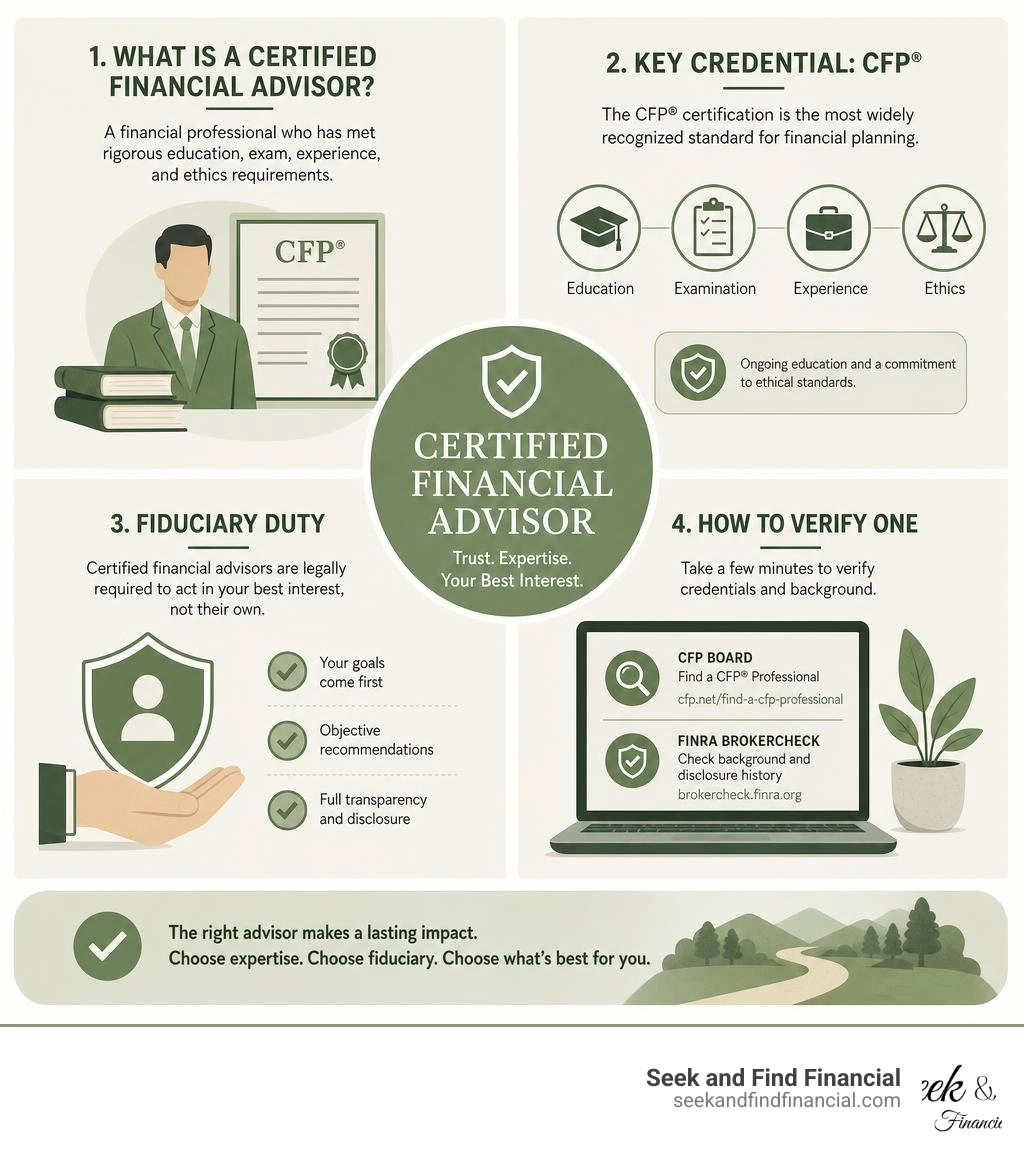
A certified financial advisor is a financial professional who has met specific education, exam, and ethics requirements set by a recognized credentialing body — most commonly the CFP Board, which awards the CERTIFIED FINANCIAL PLANNER® (CFP®) designation.
Here is a quick breakdown:
What is a certified financial advisor? A professional with a formal credential, such as CFP, that requires education, an exam, experience, and ethical standards.
What does "fiduciary" mean? They are legally required to act in your best interest, not their own.
What credential should I look for? CFP is the most widely recognized standard for financial planning.
How do I verify one? Use the CFP Board's public search tool or FINRA's BrokerCheck.
Who needs one? Anyone with complex finances, especially business owners, high earners, or people with equity compensation.
Finding the right financial planner should be simple. But the reality is that the financial services industry is full of titles, credentials, and designations that can make your head spin.
"Financial advisor." "Wealth manager." "Financial consultant." "Financial planner." These titles sound similar. But they are not the same thing. And for someone earning $400K+ with equity comp, a growing business, and a real tax burden, the wrong choice can cost you far more than just a planning fee.
The good news? There is a clear standard of excellence in the industry. And once you understand what to look for, the decision gets a lot easier.
I'm Daniel Delaney, Founder of Seek & Find Financial, and I spent years working inside established financial institutions before launching my own independent advisory firm focused on transparent, client-first planning. My background working directly with certified financial advisor clients across investment planning, retirement strategy, and wealth management gives me a clear picture of what separates great advisors from average ones.
Investing involves risk, including possible loss of principal. No investment strategy can ensure financial success or guarantee against losses. Past performance may not be used to predict future results. Provided content is for overview and informational purposes only, reflect the opinions of the author, and is not intended and should not be relied upon as individualized tax, legal, fiduciary, or investment advice.
This information is being provided only as a general source of information. These views may change as market or other conditions change. This information is not intended and should not be used to provide financial advice and does not address or account for an individual's circumstances. Past performance does not guarantee future results and no forecast should be considered a guarantee. Please seek the guidance of a financial professional regarding your particular financial concerns.
Investment advisory services offered by duly registered individuals through Seek & Find Financial LLC a Registered Investment Adviser. Licensed Insurance Professional.
Common certified financial advisor vocab:
Many people think that anyone who gives financial advice is a certified financial advisor. That is not true. In fact, anyone can call themselves a financial advisor. They do not need a special license or credential to use that title.
This is why looking for a certified professional is so important. When an advisor is certified, it means they have proven their knowledge. They have passed hard exams. They have also agreed to follow strict ethical rules.
A true certified planner looks at your whole financial picture. They do not just try to sell you a single investment product. They help you build a complete road map for your money. This includes your budget, your taxes, your investments, and your plans for retirement.
Working with a certified planner is like working with a personal trainer. They do not just tell you what to do one time. They provide ongoing guidance and keep you accountable. This helps you stay on track even when life changes. If you want to learn more about how these roles work, you can read our guide on the role of a financial management advisor.
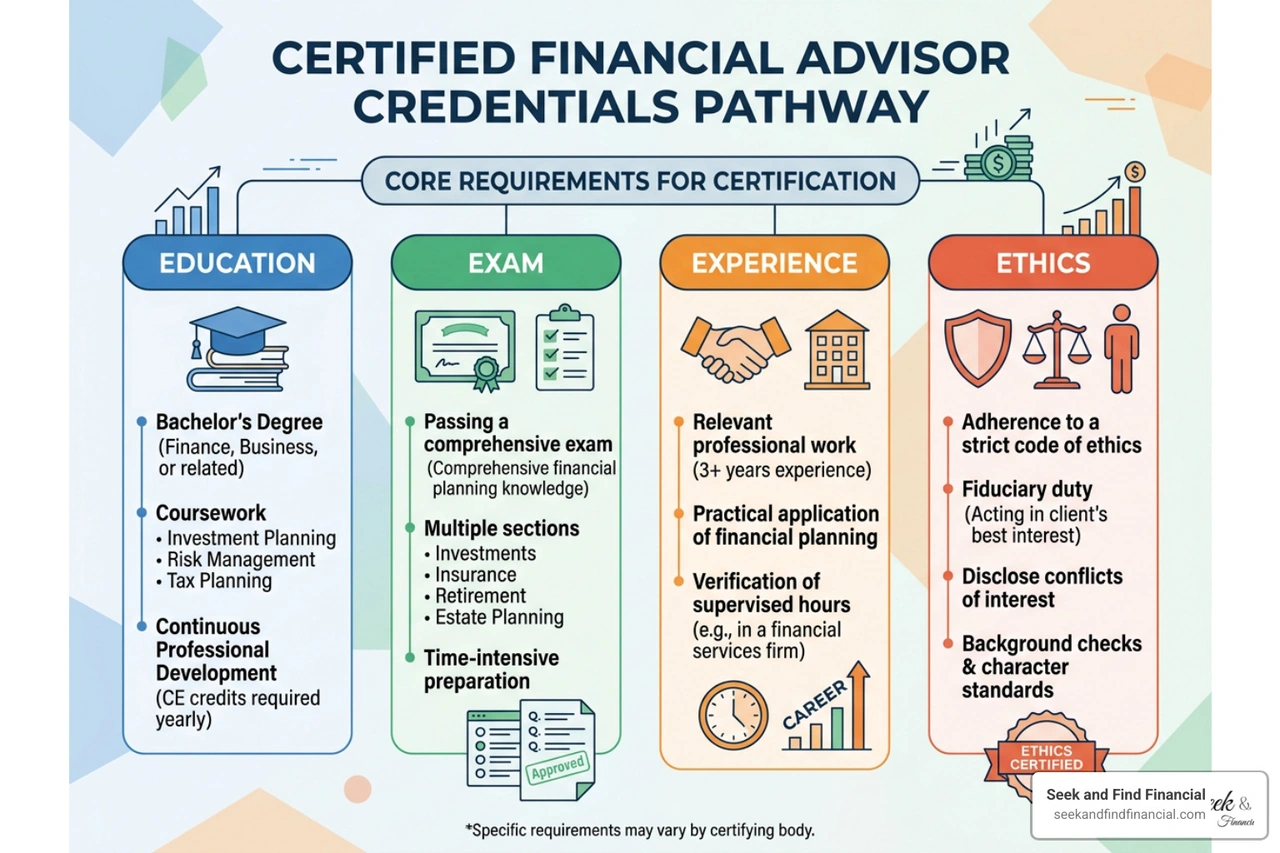
The Certified Financial Planner (CFP) mark is the gold standard in the financial planning industry. To earn this credential, a professional must meet four strict requirements. These are often called the "Four Es" of certification:
The biggest difference between a CFP professional and a standard advisor is the fiduciary duty. A fiduciary is legally required to act in your best interest at all times.
Many traditional advisors only have to follow the "suitability standard." This means they can recommend an investment as long as it is suitable for you. It does not have to be the best or lowest-cost option. Often, these advisors get paid commissions to sell specific products. This can create a major conflict of interest.
CFP professionals must put your interests first. If they do not, they can face serious consequences. The CFP Board investigates complaints and can issue public sanctions. They can even take away the advisor's certification. This strict oversight gives clients peace of mind.
When you search for a certified financial advisor, you will see many letters after people's names. It can be hard to know what they all mean. Here is a simple table to help you compare the most common credentials:

Each credential has its own strengths. For example, the Personal Financial Specialist (PFS™) credential | Resources | AICPA & CIMA is granted only to Certified Public Accountants (CPAs). These professionals combine deep tax expertise with comprehensive financial planning. This is highly valuable for business owners who want to minimize their tax burden.
To understand how different executive roles and credentials fit into your wealth strategy, check out our Financial Advisor Executives Guide.
If you have a simple financial situation, you might not need a highly certified professional. But as your wealth grows, your planning needs become much more complex.
High-income earners and business owners often face unique challenges. These include:
Generic financial advice will not work for these situations. You need an integrated plan that looks at how every decision impacts your taxes and your business. For deeper insights on this, you can read our guide on Financial Advice for Entrepreneurs.
Becoming a CFP professional is not easy. It takes years of hard work and dedication. This long path is why the credential is so highly respected.
First, candidates must complete a registered education program. These programs are often offered by top universities. They cover everything from investment theory to the federal estate tax system. In addition to coursework, students must pass a financial calculator proficiency exam. They must also complete a capstone course. In this course, they must build and present a comprehensive financial plan from scratch.

Next comes the experience requirement. Working 6,000 hours in the field takes about three years of full-time work. This ensures that a certified financial advisor has real-world practice before they give you advice. They cannot just memorize facts from a book. They must know how to help real families navigate actual financial challenges.
Even after earning the certification, the work is not done. CFP professionals must complete 30 hours of continuing education every two years. This must include at least two hours of approved ethics training. This keeps advisors up to date on new tax laws, investment tools, and planning strategies.
The demand for skilled financial planners is growing rapidly. Many people are moving away from traditional pensions and must manage their own retirement savings. This has created a strong job market for advisors.
Here are some key facts about the profession:
This strong growth shows how much people value professional financial guidance. If you are looking to partner with a firm, it helps to understand how a modern financial advisor company operates.
Finding a certified financial advisor who fits your life is a personal journey. You want to find someone who understands your goals and has experience working with people like you.
If you live in Northwest Indiana or the Chicago area, you have access to many local financial offices. Whether you are looking for an advisor in Valparaiso, Chesterton, Portage, Hebron, Merrillville, Crown Point, Hobart, or Chicago, it is important to look closely at how each firm is structured. You want to make sure you understand their credentials and how they work with clients.
When choosing an advisor, we highly recommend working with a "fee-only" planner. Fee-only advisors do not sell insurance or financial products for commissions. They only get paid directly by you for their advice. This structure eliminates major conflicts of interest and keeps the focus entirely on your goals.
Before your first meeting, it helps to be prepared. You can use our Financial Advisor Consultation Guide 2026 to learn what questions to ask.
Never take an advisor's word about their credentials. You should always verify them yourself. Fortunately, this is very easy to do online.
First, visit the CFP Board's official website. They have a tool called "Verify a CFP Professional." You can type in the advisor's name to see if their certification is active. You can also see if they have any history of public discipline.
Second, use FINRA's BrokerCheck tool. This tool shows the advisor's employment history, licensing, and any regulatory complaints or disputes.
When you interview a potential advisor, ask them these key questions:
To help you organize your finances before your meeting, check out our guide on financial advisor budget planning.
Anyone can use the title "financial advisor" without any special training. A CFP® professional has completed a bachelor's degree, passed a rigorous five-hour exam, and completed thousands of hours of real-world experience. They are also legally bound to act as fiduciaries, putting your interests first.
Planners are typically paid in one of three ways:
Most clients should meet with their advisor at least once a year for a comprehensive review. However, you should also reach out whenever you experience a major life transition, such as starting a business, receiving equity compensation, getting married, or preparing for retirement.
Choosing a certified financial advisor is one of the most important decisions you can make for your financial future. By focusing on certified, fiduciary professionals, you can protect your wealth and build a clear plan for the road ahead.
At Seek & Find Financial, we believe in clear, structured, and personalized planning. We specialize in helping entrepreneurs and business owners earning $400K+ navigate complex tax strategies and wealth management. We use modern, technology-driven tools like Altruist to give you a clear, real-time view of your progress without generic, cookie-cutter advice.
If you are ready to take control of your financial future with a clear, disciplined strategy, we invite you to learn more about What We Do.
Investing involves risk, including possible loss of principal. No investment strategy can ensure financial success or guarantee against losses. Past performance may not be used to predict future results. Provided content is for overview and informational purposes only, reflect the opinions of the author, and is not intended and should not be relied upon as individualized tax, legal, fiduciary, or investment advice.
This information is being provided only as a general source of information. These views may change as market or other conditions change. This information is not intended and should not be used to provide financial advice and does not address or account for an individual’s circumstances. Past performance does not guarantee future results and no forecast should be considered a guarantee. Please seek the guidance of a financial professional regarding your particular financial concerns.
Investment advisory services offered by duly registered individuals through Seek & find Financial LLC a Registered Investment Adviser. Licensed Insurance Professional